Why Traditional Learning Fails Busy Professionals (And What Works Instead)
Prism Skills Team
Learning Innovation
The workplace learning crisis is real. Studies show that 70% of employees feel they lack the skills needed to do their jobs, yet traditional training programs continue to disappoint. Long courses sit incomplete. Expensive workshops are forgotten within days. Something fundamental isn't working.
The Attention Economy Problem
Modern professionals face an impossible challenge: they need to learn continuously while drowning in distractions. Between Slack messages, meetings, email, and actual work, finding three hours for a training course feels like asking someone to climb Everest in their lunch break.
The average professional's attention span for passive learning has shrunk to just 8 seconds - less than a goldfish. Yet we continue to design learning experiences that demand hours of uninterrupted focus. This mismatch between how we learn and how training is delivered creates inevitable failure.
Traditional e-learning platforms compound the problem by offering overwhelming course catalogs. Faced with 50-hour certification programs, most professionals never start. Those who do rarely finish. The completion rate for online courses hovers around 15% - a staggering failure rate that we've somehow normalized.
The Knowledge Transfer Gap
Even when professionals complete training, there's a critical gap between knowing something and being able to apply it. Traditional courses focus on information transfer: watch videos, read slides, take quizzes. But real competency requires practice, feedback, and iteration.
Think about how you learned to drive. You didn't watch 40 hours of driving videos and then get your license. You practiced in short sessions, got immediate feedback, made corrections, and gradually built skill through repeated application. Yet workplace learning rarely works this way.
The result? Professionals complete training but can't translate knowledge into performance. They know the theory but struggle with execution. Organizations invest millions in learning programs that don't actually change behavior or improve outcomes.
What Actually Works: The Microlearning Revolution
The solution isn't more training - it's smarter training. Microlearning breaks the conventional model by delivering focused, bite-sized learning experiences designed around how brains actually work.
Key principles that make microlearning effective:
- Focused sessions - 10-20 minutes addressing one specific skill or concept
- Immediate application - Learn something, use it right away in your actual work
- Spaced repetition - Return to concepts over time to build lasting retention
- Contextual relevance - Content tied directly to your role and current challenges
- Practice-based - Hands-on exercises and scenarios, not just information consumption
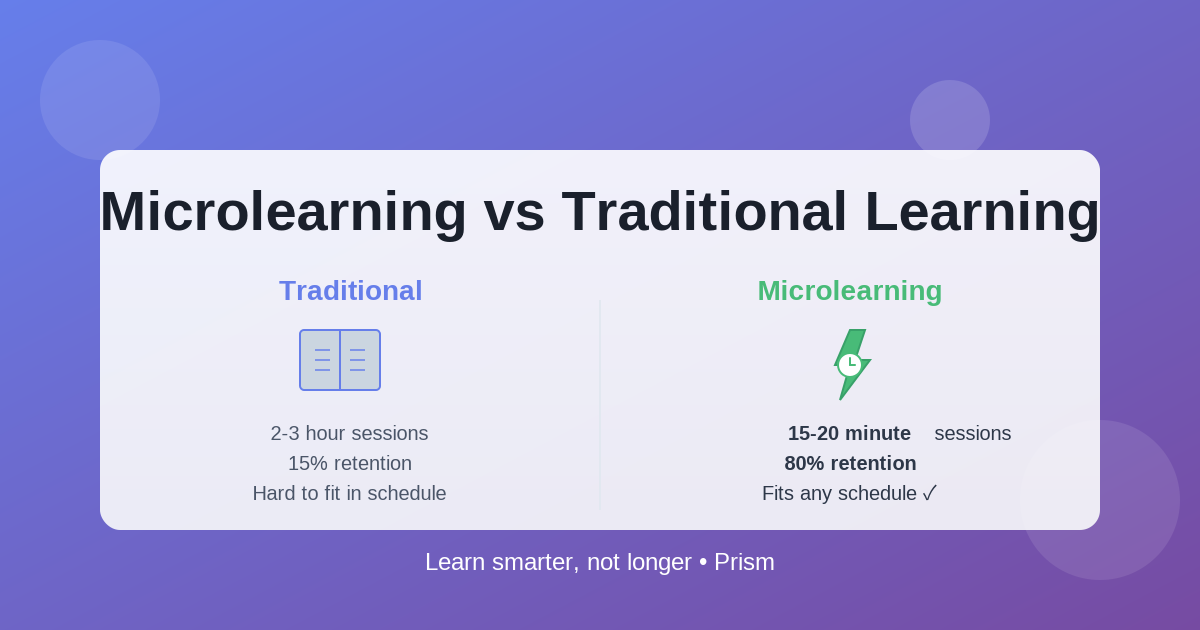
Research backs this up. Studies show microlearning improves knowledge retention by 80% compared to traditional methods. It takes 50% less time to achieve the same learning outcomes. And crucially, professionals actually complete microlearning programs because they fit into real schedules.
The AI Personalization Advantage
Modern microlearning platforms leverage AI to take personalization even further. Instead of generic content, learners get experiences adapted to:
- Their current skill level and knowledge gaps
- Their preferred learning style and pace
- Their specific role and industry context
- Their immediate work challenges and goals
This means a product manager learning data analysis gets different content and examples than a marketing manager learning the same topic. The AI adjusts difficulty dynamically, provides targeted feedback, and recommends next steps based on performance.
Making the Shift
For busy professionals, the path forward is clear:
Stop waiting for perfect conditions. You'll never find 40 free hours. Instead, commit to 15 minutes daily. That's 90+ hours annually of focused learning - far more than most professionals achieve with traditional approaches.
Prioritize application over accumulation. Don't collect courses. Instead, learn one specific skill and immediately apply it in your work. Master it through use, then move to the next skill.
Seek platforms designed for microlearning. Look for experiences that respect your time, adapt to your needs, and focus on building real capability through practice and coaching.
The future of workplace learning isn't about longer courses or more content. It's about smarter, more efficient learning experiences that actually work for how modern professionals live and work.
Ready to experience learning that fits your schedule? Prism Skills delivers personalized microlearning paths designed for busy professionals. Start building job-ready skills in just 20 minutes a day.