Three Levels of AI Enablement. Any One at Zero Takes the Whole Thing to Zero.
Babar Bhatti - Chief AI Officer, Prism Skills
There is a version of the AI enablement conversation that treats the problem as essentially a training problem. Teach people what AI is, show them how to use the tools, build some competency, and adoption follows.
Most enterprise AI initiatives are built around this model. And most of them are underperforming.
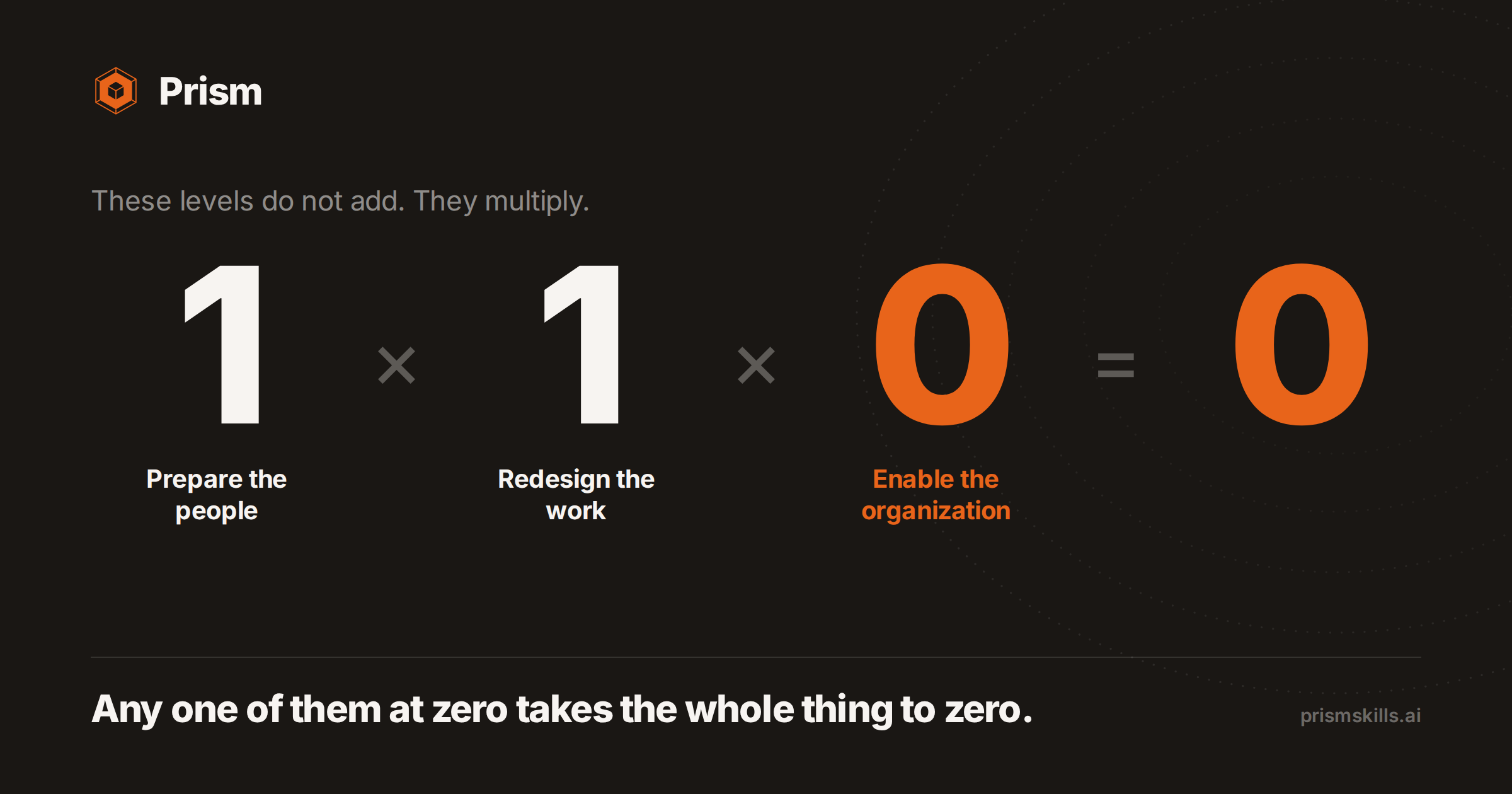
The reason isn't that training doesn't matter. It does. But training is one of three things that have to work together for AI adoption to actually take hold. And the relationship between the three is not additive. It is multiplicative.
Prepare the people × Redesign the work × Enable the organization
Any one of them at zero takes the whole thing to zero.
That single insight explains more about why AI initiatives stall than almost anything else in the enterprise AI playbook.
Level 1: Prepare the People
This is the level most organizations are investing in. AI literacy programs, prompt engineering workshops, tool-specific training, awareness sessions for leadership. It is the most visible layer, the easiest to budget for, and the one that produces the most legible outputs: completion rates, certificates, satisfaction scores.
It is also, on its own, insufficient.
Preparing people means more than teaching them what AI is or how a specific tool works. It means building the confidence, judgment, and habits that allow someone to use AI as a genuine part of how they work, rather than a novelty they experiment with occasionally and abandon when something doesn't go as expected.
That requires role-specific learning. A salesperson, a product manager, an analyst, and an operations lead all need different things from AI literacy. Generic awareness training gives everyone a surface-level understanding and almost no one the specific capability they need to change their behavior.
It also requires practice, not just content. Reading about prompting doesn't make someone good at prompting. Writing prompts, receiving feedback on why they worked or didn't, and iterating in a context that resembles real work: that is how AI fluency actually develops.
Organizations that invest heavily in Level 1 and do it well still hit a ceiling. People come out of training with genuine capability and then walk back into workflows, systems, and reporting structures that were not designed with AI in mind. The capability exists. The conditions to apply it don't.
That is a Level 2 problem.
Level 2: Redesign the Work
AI does not slot into existing workflows the way most organizations assume it will. It is not a faster version of what people were already doing. It changes what the work should look like: which parts should be done by AI, which should be done by humans, which handoffs need to be redesigned, and where the judgment calls actually sit.
Organizations that skip Level 2 end up with employees who have AI skills they have nowhere productive to apply. The workflow still expects them to do tasks the old way. The approval process doesn't account for AI-generated outputs. The meeting structure doesn't create space to verify or refine what AI produced. The performance metrics still measure what they always measured, not whether AI is being used well.
Redesigning the work means going process by process and asking a different set of questions: Where does AI reduce friction without introducing unacceptable risk? Where does human judgment matter most and should be protected, not automated? Where are the handoffs between AI output and human decision that need explicit design rather than assumption?
This is unglamorous work. It doesn't produce a completion certificate. It often requires collaboration between L&D, operations, and line managers who may not typically sit in the same planning conversation. And it is absolutely essential, because even the best-trained employees cannot consistently apply AI capability to workflows that were not designed to accommodate it.
Level 2 is where most organizations have the biggest gap relative to their Level 1 investment. They have trained people. They have not redesigned the work.
Level 3: Enable the Organization
The third level is the one that most directly determines whether Levels 1 and 2 can function at all. Organizational enablement means the systems, policies, leadership behaviors, and cultural conditions that make sustained AI adoption possible.
It includes:
Governance and policy. Employees need to know what they are allowed to do with AI: which data can be used, which tools are approved, what the review process is for AI-generated outputs that affect customers or decisions. Without clear guidance, the safest choice for most employees is to avoid AI in any situation that feels ambiguous. The policy vacuum silently kills adoption.
Leadership visibility. When senior leaders use AI visibly and talk about it specifically, in how they prepare for meetings, how they communicate, and how they make decisions rather than in town hall slogans, it signals to the organization that AI adoption is genuinely expected, not just encouraged. When leaders don't, the signal is equally clear.
Measurement that reflects capability, not just activity. If the organization tracks completion rates but not whether behavior changed, it is measuring the wrong thing and will keep making the wrong investments. Organizational enablement means building the measurement infrastructure to know whether AI is actually changing how work gets done.
Infrastructure and access. People cannot use tools they do not have access to, in environments that do not support them, on workflows that have not been cleared for AI use. The unglamorous work of provisioning, access management, and technical integration is a genuine enablement function. When it is missing, even highly motivated, well-trained employees cannot act on their capability.
Level 3 is where AI initiatives most often die quietly. The training ran. The pilot showed promise. And then the initiative stalled because the policies were unclear, the tools weren't accessible to the right people, the managers weren't modeling the behavior, or the measurement system wasn't designed to track what mattered.
Why the Multiplication Model Matters
The reason this is multiplicative rather than additive is not mathematical. It is behavioral.
An organization that prepares its people well but fails to redesign the work will see training-literate employees fall back to old workflows within weeks. The knowledge doesn't transfer because the environment wasn't built for it.
An organization that redesigns its workflows but doesn't prepare its people will see process redesign fail in implementation. The new process assumed AI fluency that wasn't there.
An organization that invests in both but fails to enable at the organizational level will see both efforts undermined by unclear policies, absent leadership models, and measurement systems that reward the wrong things.
Each level depends on the others. A serious weakness in any one of them does not reduce the outcome proportionally. It collapses it. Which is why the question for most organizations isn't "are we investing in AI enablement?" It is "which of these three levels is closest to zero for us right now, and what are we doing about it?"
Where to Start
Most organizations already know which level is their weakest. The answer tends to surface quickly when you ask the right question.
If people have gone through training but aren't using AI in their daily work, the gap is usually Level 2 or Level 3: the workflows weren't redesigned, or the organizational conditions aren't there.
If AI is being used inconsistently across teams despite equivalent training, the gap is usually Level 3: governance, leadership visibility, or measurement.
If adoption is essentially zero despite tool access and policy clarity, the gap is usually Level 1: the training was too generic to build genuine capability, or role-specific fluency never developed.
Naming the right level is the first step. Building the right intervention for that level is the work. And recognizing that all three have to function together, and that this problem cannot be solved at one level while ignoring the others, is the strategic shift that separates organizations building durable AI capability from ones running AI training programs that don't change much.
Prism Skills is built for all three levels: role-specific learning that prepares people, scenario-based practice connected to real workflows, and org-level analytics that show leaders where capability gaps are actually holding adoption back. Learn more at web.prismskills.ai.