Your Team Took an AI Course. Now What?
Babar Bhatti
Chief AI Officer, Prism Skills
You made the investment. You rolled out the AI training program — the vendor-certified course, the lunch-and-learn series, maybe a company-wide LinkedIn Learning subscription. Completion rates looked fine. Feedback scores were positive.
And then... not much changed.
Your teams are still working the same way. AI tools are open in maybe a third of the browsers, used sporadically, producing output that gets quietly discarded or heavily rewritten. The ROI you expected from the training budget hasn't materialized.
If this sounds familiar, you're not alone. And the problem isn't your team's willingness to learn. It's the kind of learning they were offered.
The Completion Rate Trap
Corporate training programs are almost universally measured by completion rates. Did everyone finish the course? Did they pass the quiz? Great — training complete, box checked.
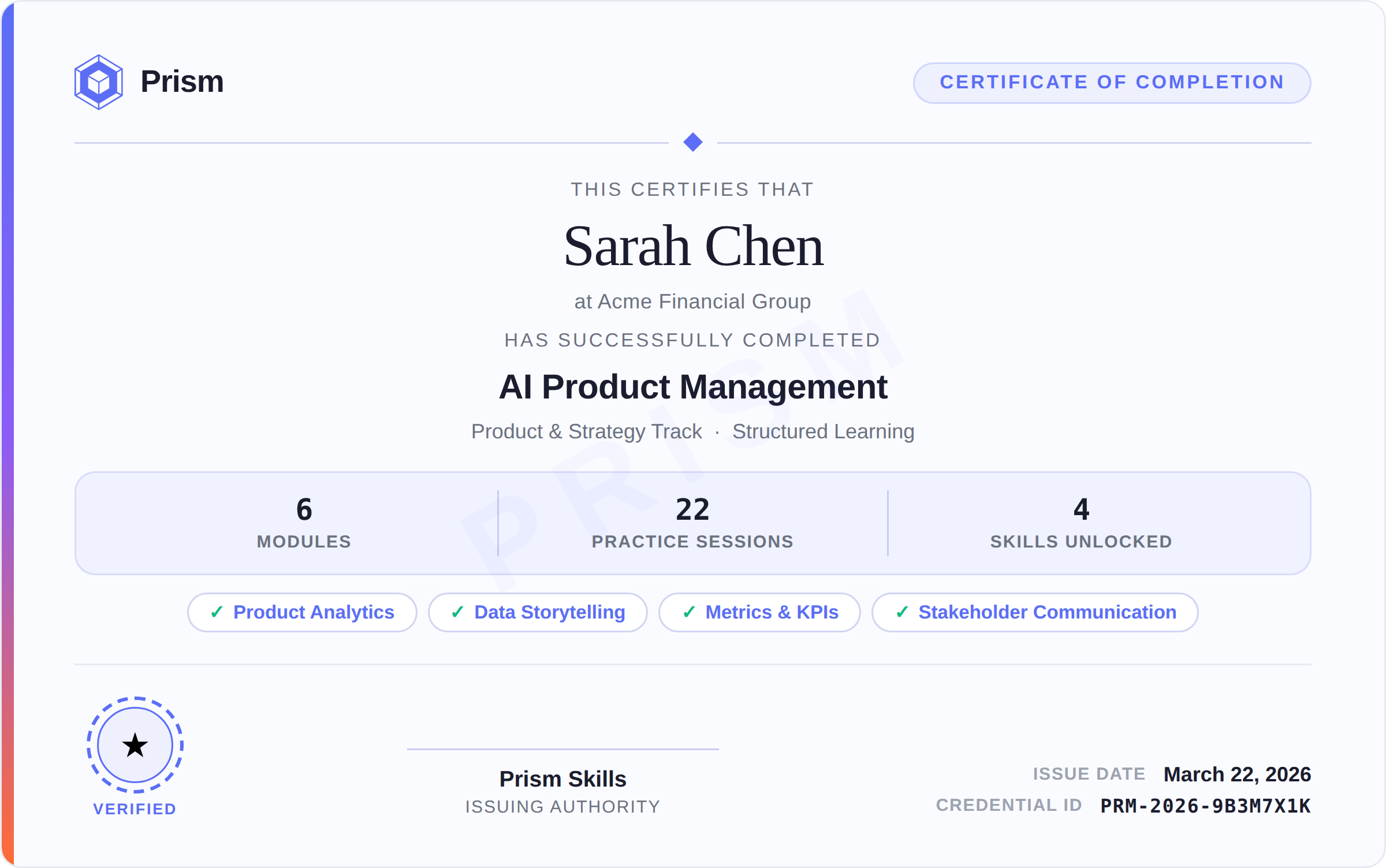
The problem is that completion is a measure of exposure, not capability. Watching an AI demo and passing a multiple-choice quiz tells you that someone sat through a program. It tells you nothing about whether they can actually use AI effectively in their job.
This matters more for AI than almost any other skill. AI fluency is fundamentally a doing skill — like writing, presenting, or running a client meeting. You don't develop it by absorbing information. You develop it through practice, feedback, and repetition until good judgment becomes instinctive.
A team with high AI training completion rates but no structured practice time is a team that knows what AI is, but still doesn't know how to use it well for their specific work.
What "Using AI at Work" Actually Requires
The gap between knowing about AI and using it productively at work is wider than most training programs acknowledge. Effective professional AI use requires:
Role-specific judgment. A finance analyst using AI to model scenarios needs very different skills than a product manager using it to synthesize user research. Generic AI training ignores this. The mental models, the common use cases, the constraints that matter — all of it varies by role.
Context fluency. The professionals getting the most leverage from AI aren't just writing better prompts. They're giving AI the right context — their industry, their constraints, their audience, their standards. That contextual judgment takes time and practice to develop, and it can't be taught in a generic course.
An iteration habit. Good AI output rarely comes from the first attempt. Professionals who use AI well have built the habit of reviewing, adjusting, and refining. That habit doesn't form from watching demos. It forms from doing it, repeatedly, with feedback on what worked and what didn't.
Confidence with ambiguity. AI tools behave unpredictably until you've spent enough time with them to develop intuition. That intuition — knowing when to trust the output, when to push back, when to start over — only comes from experience.
None of these are things a course can give someone. They're all things that have to be built through practice.
The Question L&D Leaders Should Be Asking
Most organizations evaluate AI training by asking: Did our people learn about AI?
The more useful question is: Can our people do something with AI that they couldn't do before — and are they actually doing it?
That's a harder question to answer, and traditional training programs aren't designed to produce the data that would let you answer it. Completion certificates tell you who watched the videos. They don't tell you who can write a strong prompt for a real work scenario, who has built AI into their daily workflow, or whose output quality has measurably improved.
The organizations getting ahead in AI adoption are the ones treating AI fluency as a measurable, trackable skill — not a training event.
What Effective Team AI Development Looks Like
The shift is from training-as-event to training-as-practice infrastructure. A few things that distinguish programs that actually change behavior:
Role-mapped learning paths. The content your sales team needs is different from what your analysts need, which is different from what your operations managers need. Generic AI literacy content is a starting point, not a destination. Teams that develop real AI fluency are working through scenarios that reflect their actual jobs.
Structured practice with feedback. Reading and watching build awareness. Doing builds skill. Effective programs give team members real challenges to work through — prompts to write, scenarios to navigate, outputs to evaluate — with specific feedback that tells them exactly where their judgment fell short and why.
Visibility into actual skill development. Managers and L&D teams need more than completion data. They need to know which team members are developing genuine capability and which are falling behind. Which roles have the biggest skill gaps. Where the team's AI fluency is strong and where it needs reinforcement.
Learning that fits how professionals actually work. A two-hour AI course competes with everything else on your team's plate and usually loses. Learning designed around 15–20 minute sessions that fit around real work commitments gets completed. More importantly, it gets retained — because the content is applied immediately rather than forgotten before Monday morning.
Turning Training Investment Into Capability
If your organization has already done the awareness-level AI training, you're ahead of where many teams were a year ago. But awareness isn't capability, and capability is what drives the productivity gains that justify the investment.
The next phase of AI development for most teams isn't more courses. It's structured practice — role-specific, feedback-rich, tracked, and designed to build the judgment and habits that translate into real workflow changes.
That's the shift from "we did AI training" to "our team uses AI effectively." And it's the difference between a line item on last year's L&D report and a measurable improvement in what your team can produce.
Prism Skills is built for exactly this phase: personalized learning paths mapped to specific roles, structured practice with AI-scored feedback, and org-level analytics that show where skills are developing—and where gaps remain.
Prism Skills uses personalized microlearning to help organizations build AI-capable teams—and gives professionals a clear, structured path to AI upskilling.
Designed for real-world impact, not just theory.
See how your team can build measurable AI fluency at prismskills.ai