Q1 Is Over. Is Your Team Actually More AI-Capable Than They Were in January?
Prism Skills Team
Learning Innovation
Q2 starts today. Most teams are setting new goals, reviewing pipeline, and resetting quarterly targets.
Before you do any of that, there's one question worth pausing on: is your team actually better at using AI than they were ninety days ago?
Not are they using AI more. Not do they have access to AI tools. Specifically: are they more capable? Are they producing better work with it? Are they applying it to the right problems, in the right ways, with the right judgment?
For most organizations, the honest answer is: we're not really sure.
The Measurement Gap
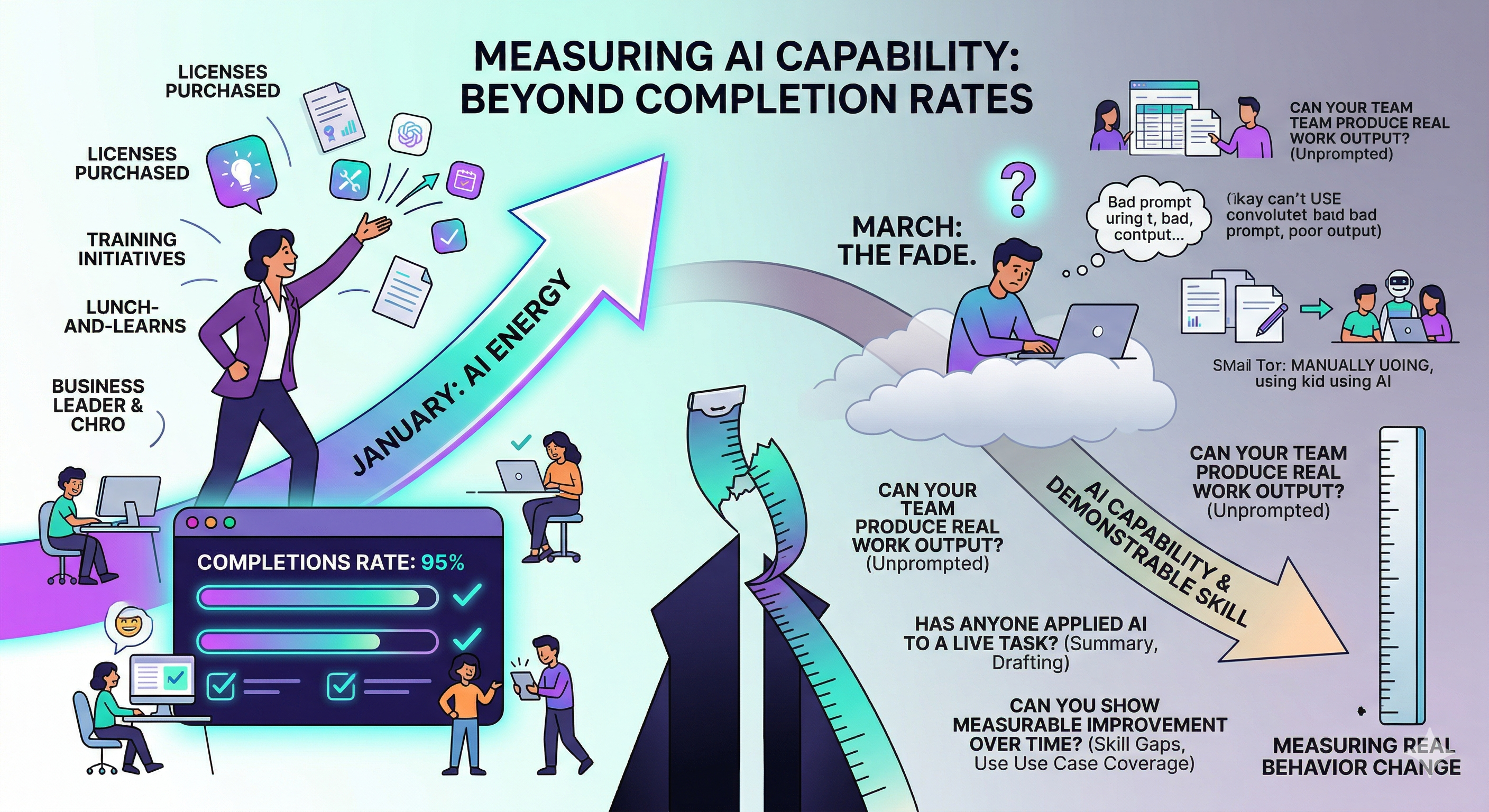
Here's the pattern that plays out in company after company. In January, there's energy around AI. Somebody — a CHRO, a CTO, an enthusiastic VP — makes it a Q1 priority. Licenses get purchased. A training initiative gets launched. Maybe there's a lunch-and-learn, or a subscription to a content library, or a mandate to use AI tools in daily work.
By March, the initiative has faded into the background. Completion rates exist. Engagement numbers are decent. But no one has actually looked at whether any of it changed behavior.
The uncomfortable truth is that most organizations have no mechanism for measuring AI capability. They can measure AI activity — logins, completions, time-on-platform — but activity and capability are not the same thing. A team member can complete six AI training modules and still write a bad prompt the following Monday.
What's missing is a direct line between learning investment and demonstrable skill.
Three Questions to Honestly Assess Q1
If you want a quick diagnostic on where your team actually stands, these three questions cut through the noise.
1. Can your team produce a real work output with AI, unprompted?
Not in a training exercise. Not when someone shows them how. On their own, in the normal flow of their work — can they use an AI tool to meaningfully improve something they produce? If the answer is "some of them, sometimes," that's where you are. It's a starting point, not a destination.
2. Has anyone applied AI to a live task in the last thirty days?
This is the behavioral test. It doesn't matter what they learned if it hasn't transferred to work. The sign of real capability isn't module completion — it's someone using AI to prepare for a client meeting, to summarize a dataset, to draft a proposal, to catch an error they'd have missed. If you can't name three or four specific examples from your team in Q1, the transfer isn't happening.
3. Can you show measurable improvement over time?
This is the organizational question. Not a snapshot — a trend. Average scores improving. Use case coverage growing. Skill gaps narrowing. If your only measurement is completion rate, you have activity data but not capability data. Those are different things, and conflating them is how organizations convince themselves progress is happening when it isn't.
Why the Gap Happens
The gap between training investment and capability growth isn't a motivation problem. Most professionals genuinely want to get better at this. It's a design problem.
Generic AI training is built for the average learner in the average role. It teaches concepts, not application. It shows what AI can do without building the judgment to know when, why, and how to use it in a specific context. A sales rep and a finance analyst and a product manager all need different AI fluency — not just different examples, but different mental models, different risk awareness, different application habits.
And passive learning — watching, reading, listening — doesn't build the muscle memory that makes capability stick. Knowing what a good prompt looks like is not the same as being able to write one under pressure. That only comes from practice with real feedback.
The organizations that made meaningful progress in Q1 are the ones that moved beyond content consumption into applied, role-specific, feedback-driven learning. They're not the majority. But the gap between them and everyone else will compound every quarter.
What Q2 Could Look Like Instead
The good news is that three months is enough time to move the needle meaningfully — if the investment is structured correctly.
The organizations that close the gap fastest share a few characteristics. Learning is tied to specific roles and specific use cases, not generic AI literacy. Practice is built into the learning, not saved for "when you're back at your desk." Progress is measured at the skill level, not just the completion level. And managers can see where their teams actually are — not just who clicked through the modules.
This is the difference between an AI training program and an AI capability program. The first produces certificates. The second produces behavioral change you can measure.
Q2 is a clean reset. If Q1 felt like checking a box, Q2 can be different. But it starts with being honest about where the gaps actually are — not where you hope they are.
Start with a Skill Gap Assessment
The most useful thing most L&D leaders could do today is get a clear picture of where their teams actually stand across the dimensions that matter: technical understanding of AI tools, business application judgment, and communication — can they explain what AI did and why it's trustworthy?
That picture, taken at the start of Q2, becomes the baseline against which Q3 progress can be measured. Without a baseline, you're flying blind again.
If you want to see what that looks like in practice, Prism Skills' team assessment tools give you exactly this — role-level skill scores, dimension breakdowns, and use case coverage that shows you not just what your team has learned, but what they can actually do.
The question isn't whether AI capability matters for your business. It does. The question is whether Q2 is the quarter you start measuring it.
Prism Skills is a personalized AI learning platform for non-technical professionals. Organizations use Prism Skills to build applied AI capability across their teams — with role-specific learning paths, hands-on practice, and analytics that show measurable skill progress over time.