The 5 AI Mistakes Professionals Make in Their First 90 Days
Prism Skills Learning Team
Learning Innovation
Almost nobody gets trained on this. You got access to a tool, maybe a demo, and then you were on your own — figuring it out between meetings, in the gaps, without anyone to tell you whether what you were doing was any good.
Given that, it's remarkable how well most people do. It also means the same five habits show up over and over, in every role and every industry, because they're what anyone would arrive at on their own. None of them are a sign you're bad at this. They're just the predictable shape of self-teaching.
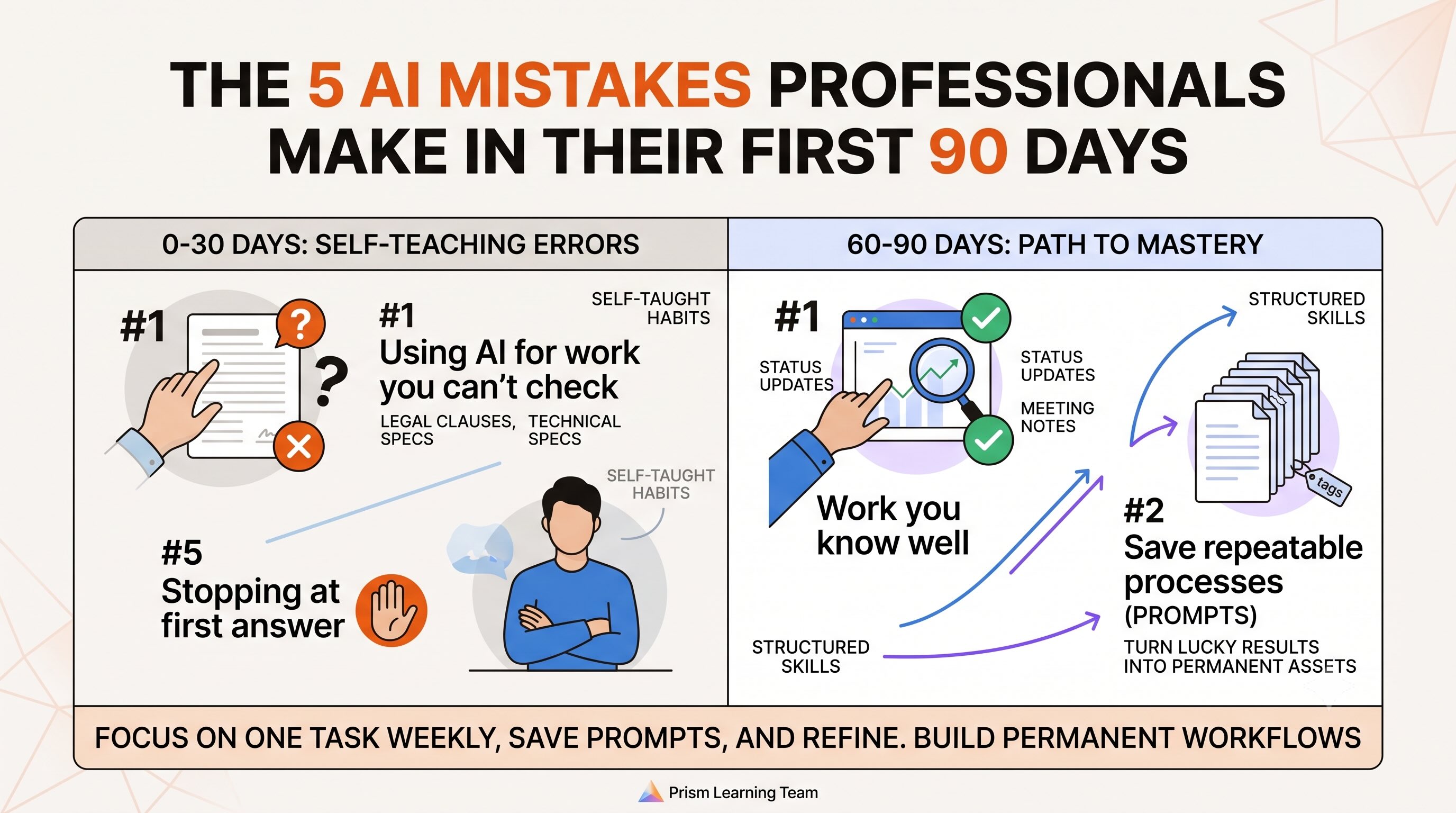
Here they are, roughly in the order they cost you the most.
1. Using AI for work you can't check
This is the expensive one, and it's easy to walk into.
The tasks where AI feels most impressive are usually the ones just outside your expertise. You ask it to explain a legal clause, draft a technical spec, summarize a regulation, and the answer comes back fluent and confident and reasonable-sounding. It feels like a superpower, because you couldn't have produced that yourself.
That's exactly the problem. You couldn't have produced it yourself, which means you also can't tell whether it's right.
Where AI earns its keep early on is the opposite: work you know well enough to grade in ten seconds. You already know what a good version looks like, so you can spot the flaw immediately, correct it, and move on. The output is faster and you stay in control of the quality.
The rule that holds up: use it to go faster on things you could have done, and much more carefully on things you couldn't. Expanding into the second category is fine — it's the whole point — but do it deliberately, with a way to verify, not by accident because the answer sounded good.
2. Treating one good result as a repeatable process
Something works. It's genuinely great. You tell a colleague about it.
Then you try it on next week's version of the same task and get something mediocre, and you can't work out what changed.
What changed is that the first time, you gave it much more than you remember. You'd been in that document all morning. You explained the situation in three paragraphs because you were thinking out loud. You mentioned the constraint, the audience, the thing your boss said in the meeting. The second time you were in a hurry, so you asked in one line.
The output tracks the input, and the input is mostly context. Most people's early wins are accidental in this specific way — they happened to over-explain, got a great result, and drew the wrong lesson about why.
The fix is unglamorous: when something works, save what you actually wrote. Not a mental note. The text. Three or four saved prompts that reliably produce good work are worth more than a hundred one-off experiments, and they turn a lucky result into something you own.
3. Learning the tool instead of the job
There's a strong pull toward learning AI as a subject. How the models work, what the terminology means, which one is best this month, how to structure the perfect prompt.
It's interesting, and it feels like progress, and very little of it changes what you do on Monday.
The people who get real value in three months tend to be narrower than that. They picked one task they do every single week — the status update, the meeting notes, the first pass at the analysis, the client follow-up — and they got genuinely good at that one thing before touching anything else. Then they picked a second one.
That's a less satisfying way to learn. You don't get the sense of surveying the field. But a task you've automated well is permanent, and a general understanding of the technology mostly isn't, because the technology keeps moving. One workflow beats a lot of reading.
4. Never seeing what better looks like
Here's a quiet one. You've been using AI for two months and you have no idea whether you're any good at it.
Not because you can't tell if the output is usable — you can. But usable against what? You've only ever seen your own attempts. There's no benchmark, no colleague looking over your shoulder, no moment where someone shows you the version that's clearly better than yours and you understand immediately why.
This is the single biggest difference between people who plateau at month two and people who keep improving. It isn't talent or time spent. It's exposure to a stronger example, which is how you learn almost anything — you see the good version, you notice the gap, you close it.
Without that, you don't stall because you're doing it wrong. You stall because everything you produce looks fine to you, and you have no reason to think it could be twice as good.
Go find the comparison. Ask a colleague who's clearly ahead of you to show you their actual prompt for something. Look at how a strong example is constructed, not just what it produced. It's a fast, cheap correction and most people never make it.
5. Stopping at the first answer
You ask. It responds. You take what's usable, fix the rest yourself, and move on.
That's a reasonable instinct and it caps your results at roughly what you can get in one shot.
The gap between the first output and the third is usually large, and closing it takes about ninety seconds. Tell it what's wrong with what it gave you. Say the tone is too formal, the second section misses the point, you need it half as long. Say it plainly, the way you'd say it to a person.
Treating it as one exchange gets you a draft. Treating it as a short conversation gets you something you'd actually send. Most people never discover this because the first answer was good enough to use, and good enough is a hard habit to break.
What a better first 90 days looks like
If you're starting over, or restarting, the shape that works is narrow and repetitive.
Pick one task you do weekly. Use AI on it every time it comes up, not occasionally. Save the prompt when it goes well. Find one example of someone doing it better than you. Push back on the first answer every time, at least once.
Then, after a month or so, add a second task.
That's it. It's slower than it sounds like it should be and considerably faster than the alternative, which is trying everything, getting scattered results, and concluding after a few months that AI is somewhat useful but not the thing everyone claimed.
Where practice helps
Four of the five above come down to the same missing piece: nobody's giving you feedback. You can't see what better looks like, you don't know why something worked, and there's no one to tell you your third attempt was stronger than your first.
That's what Prism Skills is built to supply. Lessons are 15 minutes and built around the tasks in your actual role, you practice in a guided sandbox rather than reading about it, and you get feedback on what you produced — including a comparison against a strong version, so you can see the gap instead of guessing at it.
The five mistakes aren't a knowledge problem. You could read this list, agree with all of it, and still write the same one-line prompt on Monday. They're a practice problem, which means they close the same way anything else does: by doing the thing, badly at first, with someone telling you what to fix.