Career Switchers: How to Upskill Without Quitting Your Job
Prism Skills Team
Learning Innovation
You're staring at your laptop at 11 PM, scrolling through job postings for roles you're not qualified for. You know you need to switch careers, but the catch-22 is brutal: you need skills to get the job, but you need the job to build the skills. Meanwhile, bills don't pay themselves.
Welcome to the career switcher's dilemma. You're not alone—56% of professionals want to change careers but feel trapped by lack of time, money, or clear pathways forward.
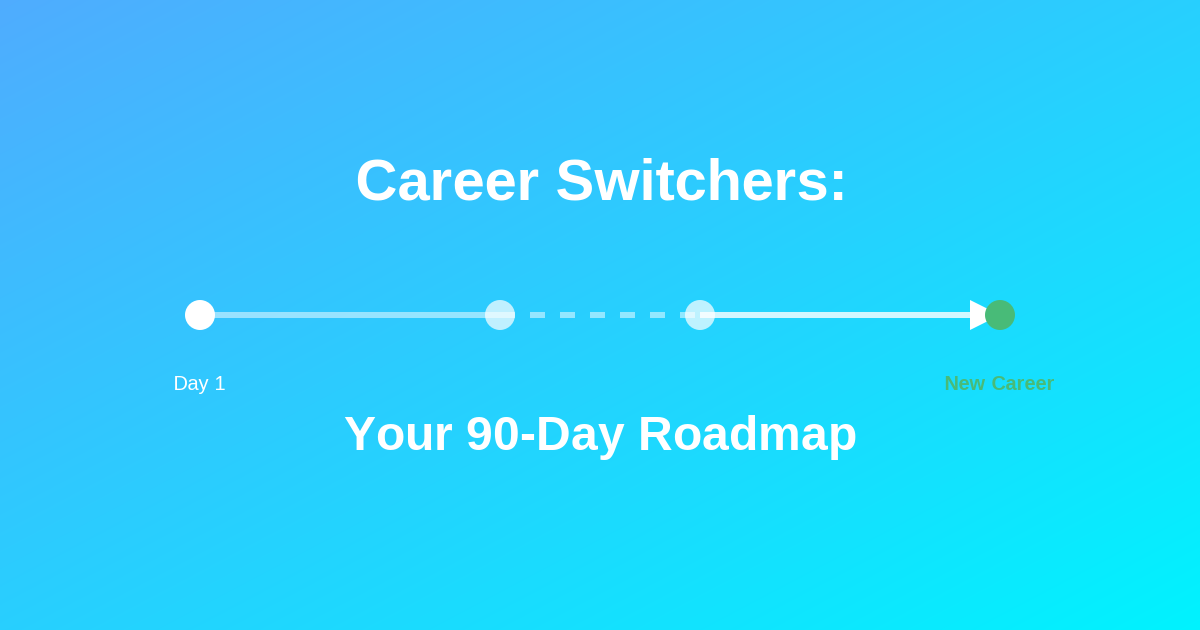
Here's the truth nobody tells you: you don't need to quit your job to switch careers. You need a strategic approach to skill-building that fits into your actual life.
The False Choices Holding You Back
Most career advice presents impossible options:
Option A: Quit your job, go back to school full-time, accumulate debt, hope it works out.
Option B: Take expensive bootcamps on nights and weekends, burn out in three weeks, give up.
Option C: Stay miserable in your current role forever, tell yourself "maybe next year."
None of these work for people with rent to pay, families to support, or lives to live. The good news? There's a fourth option that actually works.
The Skills-First Career Switch Method
Here's what successful career switchers do differently—they don't try to make a giant leap. They build a bridge.
The bridge has three parts:
- Identify transferable skills you already have
- Target 3-5 new core skills specific to your destination role
- Build proof of capability through applied projects in your current job
Let's break down each part.
Part 1: Your Hidden Assets (Transferable Skills)
You have more relevant skills than you think. A financial analyst switching to product management already has:
- Data analysis and interpretation
- Stakeholder communication
- Project prioritization
- Excel/data tools expertise
A healthcare administrator moving to tech operations brings:
- Process optimization
- Regulatory compliance thinking
- Cross-functional coordination
- System implementation experience
Your first task: List every skill from your current role. Then research 10 job postings for your target role. Circle the overlaps. That's your foundation—you're already 30-40% of the way there.
Part 2: Strategic Skill Stacking
Don't try to learn everything. Identify the 3-5 skills that will make the biggest difference.
For a marketing manager becoming a product manager:
- User research fundamentals
- Basic SQL for data analysis
- Product roadmap frameworks
- A/B testing methodology
- Wireframing/prototyping basics
For a finance professional moving to low-code development:
- No-code/low-code platforms (Bubble, Webflow, Retool)
- Basic JavaScript concepts
- API integration fundamentals
- Database design basics
- UX principles for business apps
Notice these are specific and practical—not "learn to code" or "understand business." The more precise your skill targets, the faster you'll get there.
Part 3: Build Proof While You Work
This is the secret sauce: use your current job as your learning laboratory.
Real example—Sarah, Financial Analyst → Product Manager:
Month 1: Started asking "why are we building this?" in meetings. Volunteered to talk to internal users about their pain points. Documented feedback in a simple framework.
Month 2: Learned basic SQL through 20-minute daily sessions. Started pulling her own data instead of waiting for IT. Shared insights with her manager.
Month 3: Proposed a small process improvement based on user feedback. Built a simple dashboard to track impact. Presented results to leadership.
Month 6: Applied for Associate PM role internally. Showed her user research notes, data analysis work, and the documented impact of her improvement project. Got the job.
She didn't quit. She didn't spend $15,000 on a bootcamp. She spent 20 minutes a day for six months building exactly what she needed.
Your 90-Day Career Bridge Blueprint
Here's your practical roadmap. Adapt it to your situation, but don't skip the structure.
Month 1: Foundation + Quick Wins
Week 1-2: Research & Planning
- Study 20 job postings for your target role
- Identify the 3-5 most common skill requirements
- Find people doing that job on LinkedIn—what's their background?
- Map your transferable skills
Week 3-4: First Skill + Immediate Application
- Pick ONE skill to start (choose the most immediately useful)
- Dedicate 15-20 minutes daily to learning it
- Find a way to apply it in your current job this week
- Document what you learned and the outcome
Quick win example: If you're learning user research, interview three colleagues about a pain point in your current workflow. Write up the findings. Share with your team. You just did product research.
Month 2: Deepen Skills + Build Artifacts
Week 5-6: Skill #2 + Portfolio Building
- Add second skill to your daily practice
- Start a simple portfolio (Google Doc, Notion page, or GitHub)
- Document every project, no matter how small
- Include: problem, approach, outcome, skills used
Week 7-8: Real-World Project
- Identify a problem in your current company
- Propose a solution that uses your new skills
- Even if it's not approved, you've created a case study
- Example: "Proposed customer feedback system using low-code tools—reduced manual data entry by 40%"
Portfolio tip: Quantify everything. "Improved process" is vague. "Reduced report generation time from 4 hours to 45 minutes" is compelling.
Month 3: Integration + Validation
Week 9-10: Skill #3 + Networking
- Add third core skill to your routine
- Connect with 5 people in your target role (LinkedIn coffee chats)
- Ask: "What do you actually spend your time doing?"
- Validate that your skill choices are right
Week 11-12: Polish & Prove
- Clean up your portfolio—make it shareable
- Write one article/post about what you've learned
- Update LinkedIn with new skills (with proof/projects)
- Practice explaining your career transition story in 2 minutes
The story framework: "I've spent 5 years in [current field] doing [specific work]. I realized I'm most energized when [thing that relates to new field]. Over the past 3 months, I've been building [specific skills] by [specific projects]. I'm now looking for opportunities to [target role] where I can combine my [transferable skill] background with my new [new skills]."
The Time Management Reality Check
"I don't have time" is the #1 reason people don't switch careers. Let's be honest about time.
You need: 15-20 minutes per weekday. That's 75-100 minutes per week. Not 20 hours. Not full weekends. Just tiny, consistent blocks.
Find it by:
- Wake up 20 minutes earlier (hardest but most effective)
- Use lunch break twice a week
- Replace one Netflix episode with learning
- Learn during commute (audio/reading)
- Weekend: 30-60 minutes on Sunday for reflection/planning
The compound effect: 20 minutes daily = 2.5 hours weekly = 10 hours monthly = 120 hours in 6 months. That's equivalent to three traditional college courses.
Common Traps to Avoid
Trap 1: Tutorial Hell
Watching endless courses without building anything. Fix: For every hour of learning, spend an equal hour applying it.
Trap 2: Perfectionism Paralysis
Waiting until you're "ready" to start building. Fix: Build messy projects immediately. Polish them later.
Trap 3: Isolation
Trying to do it all alone. Fix: Join communities, find accountability partners, ask questions publicly.
Trap 4: Credential Obsession
Thinking you need another degree or expensive certification. Fix: Most roles care about demonstrated capability, not credentials. Build proof.
Trap 5: Scope Creep
Trying to learn "everything about product management" instead of specific skills. Fix: Be ruthlessly specific about what you need to learn.
When to Make the Move
You don't need to be an expert. You need to be competent enough to add value from day one and capable of learning the rest on the job.
You're ready when:
- You can confidently do 60-70% of the role requirements
- You have 3-5 portfolio projects demonstrating key skills
- You can articulate why you're switching and what value you bring
- You've networked enough to get your resume in front of real people
- You can explain your skill gaps honestly and how you'll close them
Internal vs. External moves: Internal transitions are 3x easier. Your company already trusts you. You understand the business. You just need to prove you can do the new role. If possible, make your first move internally.
Real Career Switch Timelines
Realistic expectations based on starting point:
Related field switch (Marketing → Product Management): 3-6 months of focused skill-building
Adjacent field switch (Finance → Data Analytics): 6-9 months of deliberate practice
Bigger leap (Teacher → UX Designer): 9-12 months of intensive learning + portfolio building
Major pivot (Healthcare → Software Engineering): 12-18 months, possibly longer for complex technical roles
These aren't rules—they're benchmarks. Some people move faster. Some take longer. The key is consistent progress, not speed.
Your Week 1 Action Plan
Don't just read this and do nothing. Here's what to do this week:
Monday: Research phase. Spend 1 hour reading job descriptions, identifying common skills.
Tuesday: Write down your transferable skills. Be thorough—everything counts.
Wednesday: Pick your first skill to learn. Find one free, high-quality resource.
Thursday: Do your first learning session (20 minutes). Take notes.
Friday: Identify one way to apply that skill at work. Make a plan.
Weekend: Set up a simple portfolio space (Google Doc, Notion, anything). Write down your career switch goal and why.
The Mindset Shift That Changes Everything
Stop thinking "I'm not qualified for that role."
Start thinking "I'm building the qualifications for that role."
You're not an impostor trying to fake it. You're a professional deliberately acquiring new capabilities through structured practice. That's not only legitimate—it's exactly how everyone who's good at something got there.
Career switching while employed isn't easy, but it's absolutely doable. Thousands of people do it every year. The ones who succeed share one trait: they started before they felt ready, and they stayed consistent when it got hard.
Your future career is being built in 20-minute increments. Starting today.