AI Fluency Isn't a Knowledge Problem. It's About Hands-On Practice.
Babar Bhatti
Chief AI Officer, Prism Skills
You've taken the course. Watched the demos. Read the articles. You understand what a prompt is. You know the difference between GPT-4 and Claude. You've nodded along to explanations of RAG, chain-of-thought, and zero-shot prompting.
And then you open ChatGPT at work and... freeze.
The output is generic. Off-tone. Missing half the context it needed. You tweak it a few times, get something passable, and move on — quietly wondering if you're the only one who feels like they still don't really get it.
You're not. And the reason isn't intelligence or effort. It's that almost all AI training stops at the wrong point.
The Knowing-Doing Gap Is Wider Than You Think
There's a well-documented phenomenon in learning research: the gap between knowing something and being able to do it is far larger than most people expect.
We see it everywhere. You can read about swimming techniques for years and still struggle the first time you're in the water. You can study music theory without being able to play a song. Knowing the framework doesn't transfer automatically into execution.
AI is no different — and in some ways, the gap is even wider.
Why? Because working effectively with AI is not a knowledge skill. It's a craft skill. Like writing, or negotiating, or coding. The quality of your output depends on judgment built through repetition, feedback, and iteration — not on how many definitions you can recite.
Understanding what a "system prompt" is won't help you write one that works. Knowing that "specificity improves outputs" won't tell you which details matter for your use case, in your industry, for your role.
That only comes from doing it. A lot.
Why Passive AI Training Fails Professionals
Most AI courses are built around a simple model: explain → demonstrate → quiz. You watch an expert prompt the AI, see a polished result, and answer a few comprehension questions.
The problem is that expert demos are deceptively clean. The expert already knows:
- What context the AI needs to produce good output
- How to structure constraints so the AI doesn't go off-script
- What format to request so the output is actually usable
- How to iterate when the first response misses the mark
When you're watching, it looks easy. When you try it yourself, you discover how much invisible judgment went into every sentence of that prompt.
Comprehension quizzes make this worse, not better. Choosing the "best prompt" from a multiple-choice list is nothing like staring at a blank input field and writing one from scratch for a real work problem.
The result: Professionals who pass AI courses but still don't use AI confidently. Companies that invest in training and see no change in how their teams actually work.
What Real AI Practice Looks Like
Deliberate practice — the kind that actually builds skill — has a few non-negotiable ingredients:
1. You produce something, not just consume it. You write the prompt. Not fill in a blank, not choose from options — actually write it, from scratch, for a real scenario.
2. You get specific, diagnostic feedback. Not "good job" or "needs work." Feedback that tells you exactly what was missing: Did you give enough context? Were your constraints clear? Did you specify the output format? Did you include the right constraints for your role and industry?
3. You see the gap between your output and expert output. There's no better teacher than the contrast between what you produced and what a well-crafted prompt produces. That gap is the learning.
4. You iterate. A single attempt teaches you little. The skill builds in the progression: attempt → feedback → adjust → attempt again.
This is how you learn to write. How you learn to code. And it's how you learn to work with AI.
The Prompt Sandbox: From Theory to Application
This is exactly the gap that Prism Skills' Prompt Sandbox was designed to close.
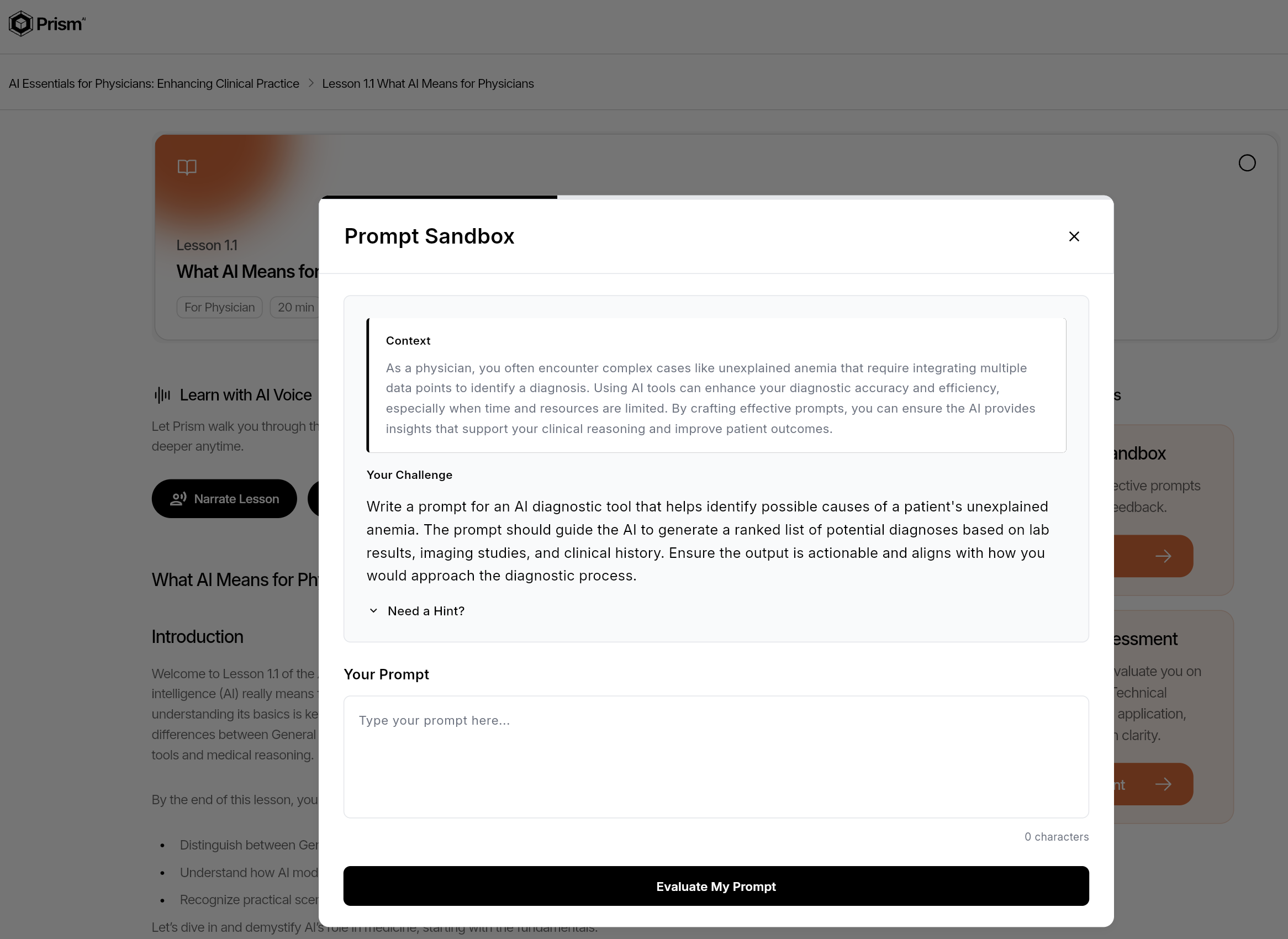
Instead of watching prompts get written, you write them — for real professional scenarios mapped to your actual role and industry. A financial services analyst gets different challenges than a product manager at a SaaS company. The context is yours, not a generic demo.
Each attempt is scored across four dimensions that mirror what actually determines prompt quality in professional settings:
- Context — Did you give the AI enough background to understand the situation?
- Constraints — Did you tell it what not to do, what guardrails to respect, what to avoid?
- Specificity — Was your request precise enough to get a useful output, or vague enough to get a generic one?
- Output Format — Did you tell the AI how to structure its response so it's immediately usable?
After each attempt, you see the score breakdown, what an improved version looks like, and a specific explanation of what you could have done differently. Not generic advice — a direct comparison between your prompt and a stronger one, so you can see exactly where the gap was.
What Learners Actually Get Better At
The improvements we see from consistent sandbox practice are predictable — because they map directly to the dimensions being practiced.
Context is usually the first thing to improve. Most people start by describing what they want without explaining why or for whom. As soon as learners see that scores jump when they add role, industry, and use case context, that habit forms fast.
Constraints take longer, but matter more at the professional level. "Write me a summary" produces something very different from "Write me a 200-word executive summary suitable for a board audience, avoiding technical jargon, and focused on financial impact." Learning to think about what you don't want is a higher-order skill — and it's one of the clearest markers of AI fluency.
Specificity and format tend to unlock usability. Learners go from outputs they have to rewrite entirely to outputs they can use directly or with minor edits. That's where the time savings that justify AI adoption actually materialize.
The Professional Stakes
This isn't just about learning faster. It's about the gap between professionals who can use AI to multiply their output quality and those who use it occasionally with mediocre results.
The professionals who are getting real leverage from AI in 2026 are not, by and large, the ones with the most technical knowledge. They're the ones who have put in the reps. Who've written hundreds of prompts, gotten feedback on what worked and what didn't, and built the intuition that only comes from practice.
That intuition is what separates a professional who uses AI to draft a solid executive briefing in 10 minutes from one who spends an hour getting mediocre output they're not sure they can send.
The knowledge gap in AI is closing fast. Everyone has access to the same courses, the same explainers, the same demos. The practice gap is where the real differentiation will happen.
Stop Reading. Start Doing.
If you've been learning about AI without practicing with it, you've been building the wrong muscle.
The next step isn't another course or another article. It's a prompt challenge — one where you write, get scored, see where you fell short, and go again.
That's how the skill actually builds. And it's exactly what Prism Skills' Prompt Sandbox is designed to give you: real practice, real feedback, real progress.
Ready to find out how your prompting actually stacks up?
Try a Prompt Challenge in Prism Skills →
Prism Skills uses personalized microlearning to help organizations build AI-capable teams—and gives professionals a clear, structured path to AI upskilling, designed for real-world impact, not just theory. See how Prism Skills helps teams build measurable AI fluency at prismskills.ai.