AI Adoption Is Not a Training Problem. It Is a Change Management Problem.
Babar Bhatti - Chief AI Officer, Prism Skills
Inspired by Gartner's research on the essential ingredients for successful AI literacy and change management.
Most organizations are approaching AI adoption the same way they approached every major technology rollout of the last two decades: schedule some workshops, give people access to the tools, and wait for adoption to follow.
It isn't working.
Completion rates look fine on paper. People attend the sessions. They nod along. Some of them even experiment with a tool or two in the first week. And then, quietly, nothing changes.
The problem isn't that employees don't want to use AI. The problem is that organizations have underestimated what AI adoption actually requires.
Why AI Is Different From Every Technology You've Rolled Out Before
When you introduced a new CRM, a new project management platform, or a new analytics tool, you were asking employees to learn a new system. The workflow still made sense. The role still made sense. You just needed people to click different buttons in a different interface.
AI doesn't ask that. AI asks people to rethink the work itself.
It asks: Which parts of your job should you still be doing manually? How do you make a decision when AI is surfacing options you didn't generate yourself? Where does your judgment matter more than the model's output? What does it mean to be good at your job when some of what made you good is now automated?
These aren't training questions. They're organizational and psychological ones.
That's why Gartner's research on AI literacy highlights a point that most L&D teams are not fully internalizing: AI adoption requires significantly more support than most technology initiatives — including more training, and significantly more change management.
The gap isn't skills. It's confidence, clarity, and context.
Where AI Initiatives Lose Momentum
The dropout pattern for AI initiatives is predictable, and it doesn't show up in completion metrics. It shows up three to four weeks after training ends.
Here's what typically happens:
Someone attends an AI workshop. The content is good — probably covers large language models, prompting basics, and a few use case examples. They leave curious. They try the tool once or twice. One attempt goes well. The next one doesn't. They're not sure if they did something wrong or if the tool has limits. They have a deliverable due. They fall back to the way they've always worked.
They didn't fail the training. The training failed to connect to their work.
AI dropout happens when:
- Training is too generic. A finance analyst and a marketing manager sitting through the same AI literacy module will leave with the same abstract knowledge and no idea how to apply it to their actual jobs.
- Tools feel disconnected from daily work. If there's no bridge between "here's how AI works" and "here's how AI improves the report you write every Friday," the gap stays open.
- Risk feels unclear. Employees worry about getting things wrong, sharing sensitive information, or producing work that can't be verified. Without guidance, the safest choice is to not use AI at all.
- There are no early wins. If someone doesn't experience a genuine time-saving or quality improvement in the first two weeks, the habit doesn't form.
The biggest risk isn't that employees "don't learn AI." It's that they try it, feel uncertain, fail to see the relevance, and quietly opt out — while the organization reports healthy training completion numbers and wonders why adoption is flat.
The Role-Relevance Gap
Here's a question worth asking about your current AI training program: Could your head of sales and your head of operations sit through the same content and both leave with something actionable?
If the answer is yes, the content is probably too generic to change either of their behaviors.
Effective AI literacy isn't awareness training. It's role-specific capability building. A manager needs to learn how to use AI to synthesize team updates, draft feedback, and prepare for performance conversations. An analyst needs to learn how to validate AI-generated outputs and apply critical judgment to model recommendations. A salesperson needs to learn how to use AI to research prospects, draft outreach, and prepare for objections — not how large language models work in general.
When AI training is decoupled from a person's actual role, it becomes intellectually interesting and practically useless. The knowledge doesn't transfer because the learner was never shown where to put it.
Role relevance is not a nice-to-have. It is the difference between AI training that changes behavior and AI training that generates a completion certificate.
Who Your AI Force Multipliers Are
If you want AI adoption to actually spread across an organization, you can't wait for everyone to get there at the same speed. You need to identify and prioritize the people who can influence adoption in others.
These are your AI force multipliers.
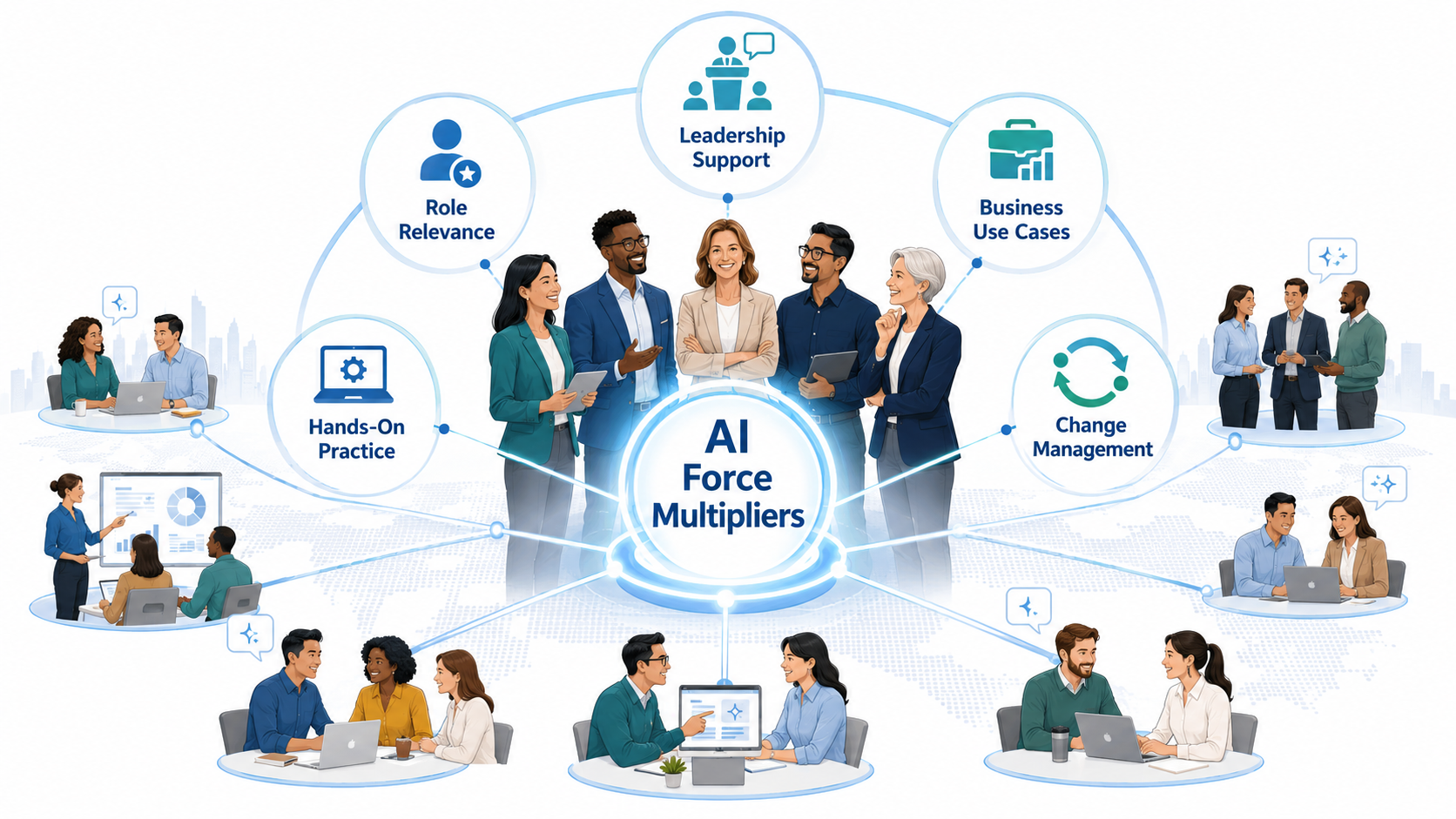
They are not necessarily the most technical people in the organization. They are the people whose behavior others notice and follow — the managers whose teams watch how they work, the process owners who define how workflows get done, the high-performers who informally set the standard for what "good" looks like.
AI force multipliers typically include:
- Managers and team leads who model how AI fits into planning, communication, and decision-making
- Business process owners who can redesign workflows to incorporate AI tools at the right points
- High-performing individual contributors who other team members watch and emulate
- Internal change champions who are energized by the technology and willing to support their peers
- Functional leaders in sales, marketing, operations, finance, and HR who can translate AI into their domain's language
When these people become confident, capable AI users, two things happen. First, they solve real problems with AI that others can see. Second, they provide informal permission — their peers feel safer trying something that a respected colleague is already doing publicly.
Organizations that try to train everyone at once, at the same level, with the same content, often end up with surface-level adoption everywhere and deep adoption nowhere. Prioritizing force multipliers first builds momentum that the broader rollout can then follow.
What Effective AI Literacy Programs Actually Need
Gartner's research points to four essential ingredients for AI literacy success. They map closely to what separates programs that change behavior from programs that generate completion reports.
1. Role relevance. Learning must connect directly to what someone does every day. Not "here is how to write a prompt" but "here is how to use AI to cut the time you spend on [specific recurring task] in half."
2. Hands-on practice with real feedback. Reading about AI doesn't build AI fluency. Writing prompts, testing outputs, understanding why something worked and why something didn't — that's where capability actually develops. This requires structured practice environments, not passive content consumption.
3. Leadership visibility and alignment. If the people above someone in the organization aren't using AI visibly, the message employees receive is that this isn't really a priority. Leadership participation isn't symbolic — it's structural. It tells employees where the organization is actually going.
4. Connection to business problems. Every AI literacy program should be able to answer the question: what business outcome are we improving? If the answer is "we're helping people feel more comfortable with AI," that's not a business outcome — it's a sentiment goal. The program needs to connect to workflow improvement, decision quality, productivity, or cost reduction to earn sustained investment and attention.
AI Literacy Is Now a Business Strategy Issue
The organizations that will build durable AI advantage in the next two years are not the ones with the best AI tools. Tools are increasingly commoditized. The advantage comes from people who know how to use them — consistently, confidently, and in ways that connect to real work.
That requires treating AI literacy as a strategic program, not a training initiative.
It means assigning accountability for adoption outcomes, not just completion rates. It means designing role-specific learning paths, not one-size-fits-all workshops. It means measuring whether behavior changed, not just whether content was consumed. And it means embedding AI adoption into how the organization operates — not running it as a separate L&D program off to the side.
AI literacy is not valuable because employees can explain what AI is. It becomes valuable when employees can use AI to improve the way work gets done. That requires training. But it also requires change management, leadership alignment, and a clear connection to business value.
The organizations treating it as a training problem will keep getting training results.
The ones treating it as a change management problem will get adoption.
Check out the Gartner webinar here.
Prism Skills is built for organizations that want both. Role-specific learning paths, hands-on practice with real feedback, and analytics that measure capability — not just completion. Learn more at web.prismskills.ai.