The 30-Minute Skills Gap Audit: Find What's Holding You Back
Prism Skills Team
Learning Innovation
You know you need to upskill. The question is: upskill in what?
Most people guess. They see what's trending on LinkedIn, pick something that sounds important, and hope it'll move their career forward.
The result? Six months and $2,000 later, they've learned skills that don't matter for their actual goals.
Research shows: 78% of professionals can't accurately identify their most critical skill gaps. They're filling gaps that don't exist while ignoring the ones that do.
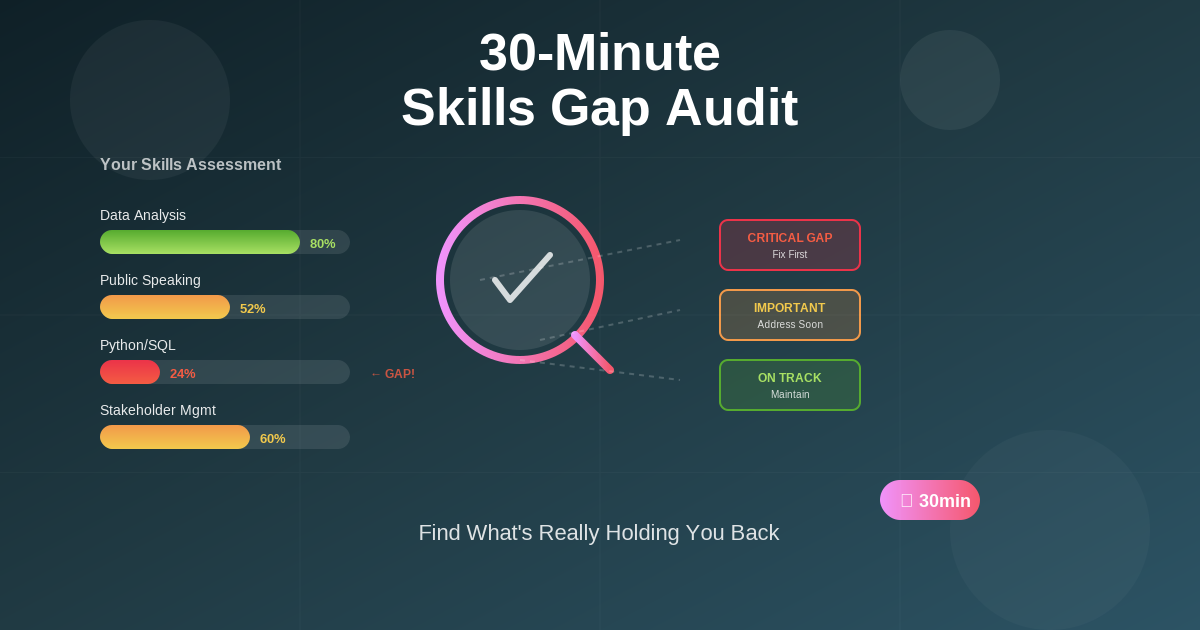
Here's a better approach: a systematic skills gap audit that takes 30 minutes and tells you exactly what's blocking your next career move.
Let's do it.
Why Most People Get This Wrong
Before we start the audit, understand why this is hard:
Problem 1: You Don't Know What You Don't Know
The Dunning-Kruger effect in action:
- You think you're "pretty good" at something
- Actually, you have just enough knowledge to be dangerous
- Real experts see gaps you don't even recognize exist
Example: You think you're decent at "data analysis" because you use Excel. Meanwhile, hiring managers expect SQL, Python, statistical significance testing, and visualization storytelling. You don't even know those are separate skills.
Problem 2: Job Descriptions Lie
What the job posting says: "Strong communication skills"
What the hiring manager actually wants:
- Executive presence in board meetings
- Ability to explain technical concepts to non-technical stakeholders
- Written communication that drives action
- Conflict resolution in cross-functional teams
- Public speaking for company presentations
You can't close a gap if you don't know what the gap really is.
Problem 3: You're Comparing Against the Wrong Benchmark
Wrong comparison: "Am I better at this than my current teammates?"
Right comparison: "Am I as good as the people already doing the job I want?"
Example: You're the best data analyst on your team. Great! But the people getting promoted to Senior Data Scientist have PhD-level statistics knowledge, publication track records, and can build production ML pipelines. Your "best on the team" isn't relevant.
Problem 4: Skills Shift Faster Than You Think
What was valuable 3 years ago ≠ What's valuable now
Example timeline:
- 2020: "Know Excel" was enough for most analyst roles
- 2023: "Know SQL + Excel" became the baseline
- 2026: "SQL + Python + AI tool fluency" is expected
- 2027: Who knows what shifts next?
If you're not auditing regularly, you're optimizing for yesterday's job market.
The 30-Minute Skills Gap Audit
Set a timer. Grab a notebook. Let's go.
Phase 1: Define Your Target (5 minutes)
Pick ONE specific goal. Not vague career growth. A specific next move.
Examples:
- Get promoted to Senior Product Manager at my company
- Switch from finance to data analytics
- Move from IC contributor to team lead
- Get hired at a Big Tech company
- Become a fractional executive / consultant
Write down:
- Target role: _______________________
- Timeline: _______________________ (6 months? 1 year? 2 years?)
- Why this goal: _______________________
Be specific. "Senior PM at my company" is different from "Senior PM at a startup" which is different from "Senior PM at Google."
Phase 2: Reverse Engineer Success (10 minutes)
Now research what it actually takes to get there.
Step A: Find 5-10 People Already There
Where to look:
- LinkedIn: Search "[your target role]" + filter by company/industry
- Your company: Who has the role you want?
- Your network: Anyone who made this transition?
Study their profiles:
- What skills do they list?
- What experiences do they highlight?
- What patterns emerge across all of them?
Create a skill inventory from their profiles.
Step B: Analyze 10 Job Postings
Find job postings for your target role at companies you'd want to work at.
List every skill mentioned across all postings:
- Technical skills
- Soft skills
- Tools/platforms
- Certifications
- Experience types
Count frequency: Which skills appear in 80%+ of postings? Those are non-negotiable.
Step C: Talk to One Person Doing the Job
If possible, message someone on LinkedIn:
"Hi [Name], I'm working toward a role in [field] and noticed your background in [specific thing]. Would you be open to a 15-minute call to share what skills have been most valuable in your work?"
Ask them:
- What skills do you use daily?
- What do you wish you'd learned earlier?
- What separates good from great in this role?
- What's changing in the field right now?
This 15-minute conversation beats hours of guessing.
Phase 3: Self-Assessment Reality Check (10 minutes)
Now assess yourself honestly against the skills you identified.
For each skill, rate yourself:
- 0 - Never heard of it / Can't do it
- 1 - Aware it exists, could Google it
- 2 - Can do basics with heavy Googling
- 3 - Proficient, can do independently
- 4 - Advanced, can teach others
- 5 - Expert, recognized leader
Critical rule: Be brutally honest. Inflating your self-assessment helps no one.
Example skill assessment:
| Skill | Required Level | Your Level | Gap |
|---|---|---|---|
| SQL | 4 | 2 | -2 |
| Python | 3 | 0 | -3 |
| Stakeholder management | 4 | 3 | -1 |
| Data visualization | 3 | 4 | +1 |
| Statistical analysis | 3 | 1 | -2 |
Color code your gaps:
- Red (Critical): Gap of -3 or worse, skill appears in 80%+ of job postings
- Yellow (Important): Gap of -2, skill appears in 50%+ of postings
- Green (Nice to have): Gap of -1, or skill you already exceed requirements
Phase 4: Prioritize Your Gaps (5 minutes)
You can't fix everything at once. Prioritize using this framework:
For each critical gap, ask:
- Impact: Will closing this gap directly unlock opportunities?
- Urgency: Is this blocking me right now or in 6 months?
- Feasibility: Can I realistically develop this skill in my timeline?
- Leverage: Will this skill compound with other skills I have?
Score each gap (1-5 on each dimension) and rank by total score.
Your Top 3 gaps are what you work on first.
Example prioritization:
Gap 1: SQL (from 2 → 4)
- Impact: 5 (required for every data role)
- Urgency: 5 (blocking me now)
- Feasibility: 4 (can learn in 3 months)
- Leverage: 5 (enables other data skills)
- Total: 19 ← TOP PRIORITY
Gap 2: Python (from 0 → 3)
- Impact: 4 (important but not always required)
- Urgency: 3 (needed in 6-12 months)
- Feasibility: 3 (longer learning curve)
- Leverage: 5 (opens many doors)
- Total: 15
Gap 3: Public speaking (from 2 → 4)
- Impact: 3 (helps but not required)
- Urgency: 2 (nice to have)
- Feasibility: 4 (can practice immediately)
- Leverage: 3 (useful but not game-changing)
- Total: 12
Focus on SQL first. Ignore public speaking for now.
Common Audit Findings (And What They Mean)
Finding 1: "I'm Missing Foundational Skills"
What it looks like: You want to be a data scientist but you're at level 1-2 in statistics, Python, and SQL.
What it means: You're 12-18 months away from being competitive, not 3-6 months.
What to do:
- Adjust timeline expectations
- Build foundations before advanced skills
- Consider intermediate roles as stepping stones
Don't: Jump straight to machine learning. You'll fail.
Finding 2: "I Have Skills, Wrong Domain"
What it looks like: You're a 4/5 in project management, data analysis, stakeholder communication—but all in healthcare. You want to switch to fintech.
What it means: Your skills transfer, but you lack domain credibility.
What to do:
- Learn industry-specific knowledge (regulations, terminology, norms)
- Build one portfolio project in the new domain
- Network with people in the target industry
The gap isn't skills, it's context.
Finding 3: "I'm One Skill Away"
What it looks like: You're strong across 80% of required skills. One critical gap is holding you back.
What it means: You're 3-6 months from being qualified.
What to do:
- Laser focus on that one skill
- Apply it in current role to build proof
- Use it to differentiate in applications
This is the best scenario. Clear gap, clear path.
Finding 4: "I'm Overqualified but Underpaid"
What it looks like: You exceed requirements for your target role but haven't been promoted/hired.
What it means: The gap isn't skills—it's:
- Visibility (people don't know what you can do)
- Communication (you're not articulating value)
- Politics (blocked by factors outside skill)
- Market timing (wrong company/industry)
What to do:
- Document your capabilities publicly
- Apply externally to test market value
- Have direct promotion conversation with manager
Skills won't fix this. Strategy will.
Finding 5: "I'm in the Wrong Career"
What it looks like: Your current skills have 0-10% overlap with your target role requirements.
What it means: This isn't upskilling, it's career switching.
What to do:
- Acknowledge this is a 1-2 year journey
- Find transferable skills (there are always some)
- Take a bridge role or internship if necessary
- Don't expect a lateral transition
This isn't a gap. It's a pivot.
The Action Plan Template
Based on your audit, create a 90-day action plan:
Month 1: Skill #1 (Highest Priority Gap)
Goal: Move from level __ to level __
Daily action (20 min/day): _______________________
Application opportunity: _______________________
Progress check: _______________________
Month 2: Skill #1 (Continued) + Skill #2 (Second Priority)
Goal: Skill #1 to level __, Skill #2 started
Daily action: _______________________
Application opportunity: _______________________
Progress check: _______________________
Month 3: Integration & Proof
Goal: Use both skills in a real project
Project: _______________________
Deliverable: _______________________
Portfolio piece: _______________________
Re-Audit Date: _______________
Set a calendar reminder to re-run this audit in 90 days.
Red Flags That Your Audit Is Wrong
Warning signs you're fooling yourself:
Red Flag 1: "I Don't Have Any Major Gaps"
Reality check: If you're not getting the opportunities you want, you have gaps. You're just not seeing them.
Fix: Get external feedback. Ask someone doing the job you want to review your skills.
Red Flag 2: "I Need to Learn Everything"
Reality check: You're probably overwhelming yourself and not prioritizing.
Fix: Force yourself to pick the top 3. Everything else waits.
Red Flag 3: "All My Gaps Are 'Soft Skills'"
Reality check: Soft skills are real, but if you have zero technical gaps, you might not be aiming high enough.
Fix: Look at more senior roles. What technical depth do they require?
Red Flag 4: "My Gaps Are All Things I Can't Control"
Example: "I need an MBA" or "I need 10 years experience" or "I need to work at Google first"
Reality check: You're identifying barriers, not skill gaps.
Fix: Look for workarounds. How do people without those credentials get the role?
Red Flag 5: "My Gaps Match Exactly What's Trendy"
Example: Everyone says "learn AI" so your #1 gap is... AI skills.
Reality check: Are you being strategic or following hype?
Fix: Go back to job postings and real role requirements. What do they actually ask for?
Advanced Audits for Specific Goals
For Internal Promotion
Special considerations:
- What skills does your manager value most?
- What skills does the promoted person have that you don't?
- What "unwritten requirements" exist at your company?
Audit addition: Talk to your manager directly. Ask:
"What skills would I need to develop to be considered for [role]?"
For Career Switching
Special considerations:
- What transferable skills do you have?
- What's the minimum viable skillset to get your foot in the door?
- What bridge roles could you take?
Audit addition: Find people who made your exact transition. What path did they take?
For Freelance/Consulting
Special considerations:
- What skills can you monetize immediately?
- What skills build long-term reputation?
- What skills differentiate you from competitors?
Audit addition: Research what successful consultants in your niche charge for and deliver.
The 6-Month Reassessment
Don't make this a one-time exercise.
Every 6 months, re-run the audit:
- What gaps did you close?
- What new gaps emerged?
- Did your target role change?
- Are you on track?
Track your progress:
| Date | Skill | Level | Notes |
|---|---|---|---|
| Feb 2026 | SQL | 2 | Starting point |
| May 2026 | SQL | 3 | Can write complex queries |
| Aug 2026 | SQL | 4 | Built 3 dashboards at work |
Visual progress is motivating and keeps you accountable.
The Bottom Line
You can't fix what you can't see.
Most professionals drift through their careers, vaguely aware they "should learn new things" but never systematically identifying what actually matters.
The 30-minute audit gives you:
- Clear picture of where you are
- Specific gaps blocking your goals
- Prioritized action plan
- Roadmap to close those gaps
Do this audit today. Not next week. Not when you "have more time."
30 minutes now saves you 6 months of learning the wrong things.
Your next career move is waiting on the other side of 2-3 critical skill gaps.
Find them. Fix them. Move forward.